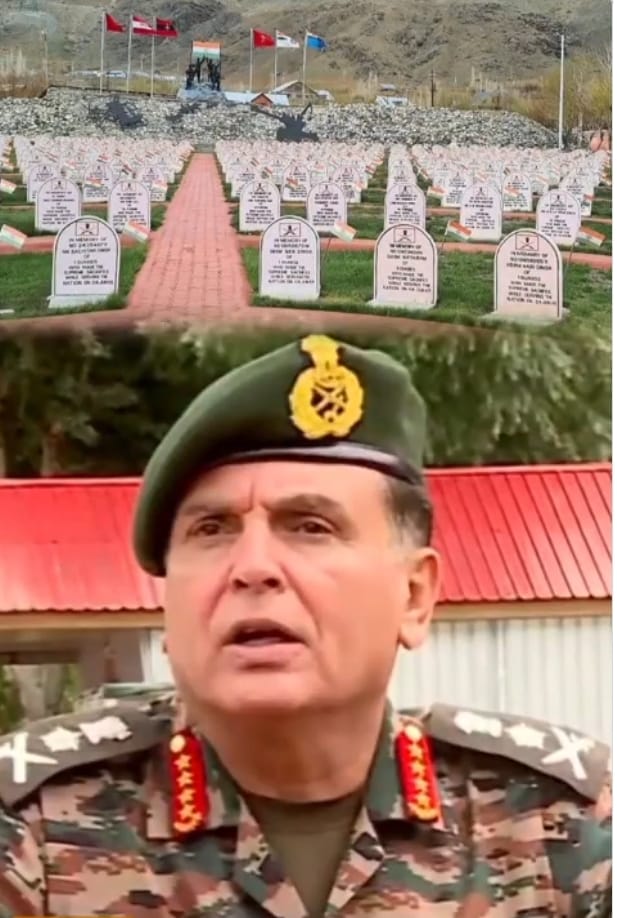

‘Everyone Must Die, Yet You Died Proving Your Loyalty’: A Powerful Tribute to the Bravehearts of Kargil by COAS Gen Dhiraj Seth
Everyone must die, yet you died proving your loyalty. You fell while fighting; you shall not be forgotten. Your image is etched upon the face of the earth, And your name has become immortal……………. COAS Gen Dhiraj Seth!
By M S Nazki
– The brave die never, though they sleep in dust: Their courage nerves a thousand living men.
-Ancient Greek Epitaph / Memorial Tradition: For love of country they accepted death, and thus resolved all doubts, and made immortal their patriotism and their virtue…
-It is foolish and wrong to mourn the men who died. Rather, we should thank God such men lived………
-Captain Manoj Kumar Pandey (Param Vir Chakra): If death strikes before I prove my blood, I promise, I will kill death.
– The true soldier fights not because he hates what is in front of him, but because he loves what is behind him…
– Freedom is never more than one generation away from extinction. We didn’t pass it to our children in the bloodstream. It must be fought for, protected, and handed on for them to do the same……….
-Those who have long enjoyed such privileges as we enjoy forget in time that men have died to win them.
-The brave die never, though they sleep in dust: Their courage nerves a thousand living men……..
-Patriotism is not short, frenzied outbursts of emotion, but the tranquil and steady dedication of a lifetime….
-Some people live an entire lifetime and wonder if they have ever made a difference in the world. A veteran does not have that problem……
-The Kargil War of 1999 holds many lesser-known accounts of grit beyond the famous front-page battles, featuring quiet acts of survival like
-Flight Lieutenant Gunjan Saxena’s combat sorties, the raw grit of teenage commando Yogendra Singh Yadav, and the crucial logistics lifeline maintained by the Army Aviation.
-High-Altitude Courage and Survival 19-Year-Old Param Vir Chakra: Grenadier Yogendra Singh Yadav was just 19 when he scaled the sheer, snow-covered vertical cliff of Tiger Hill, taking multiple bullet wounds while managing to silence enemy bunkers.
-The Batalik Ridge Push: Captain Manoj Kumar Pandey led his Gorkha Rifles through freezing nights at Khalubar, taking enemy fire directly to clear paths for his men before falling in the line of duty.
-The Unseen Support System First Woman in the Combat Zone: Flight Lieutenant Gunjan Saxena flew critical medical evacuation and reconnaissance sorties in a Cheetah helicopter across Tololing and Batalik under direct enemy missile and artillery fire.
-The Air and Supply Lifeline: Army Aviation Corps and transport pilots flew continuous missions to drop rations and evacuate over 900 casualties from extreme heights where lack of oxygen made physical movement agonizing.
-Kargil Vijay Diwas is celebrated every year on July 26 to honor India’s victory in the 1999 Kargil War.
– It marks the success of Operation Vijay in evicting Pakistani intruders from the high outposts in Ladakh.
-Historical Context:
The Conflict: Fought for over two months during May and July 1999 in the Kargil district of Jammu and Kashmir (now Ladakh).
-Operation Vijay: Launched by the Indian Army to reclaim commanding mountain heights occupied by infiltrators along the Line of Control.
-The Outcome: Victory was officially declared on July 26, 1999, after successful military operations by the Armed Forces.
-Significance and Observance Tributes:
-The nation pays homage to fallen soldiers at the Kargil War Memorial in Drass, Ladakh, and across various military installations.
-National Pride: Reminds citizens of the bravery, grit, and supreme sacrifice of war heroes like Captain Vikram Batra and Grenadier Yogendra Singh Yadav.
-The Kargil War was an intense high-altitude mountain conflict fought between India and Pakistan from May to July 1999 in the Kargil district of Ladakh.
-Pakistani forces crossed the Line of Control (LoC) during the winter of 1998–1999 under the code-named Operation Badr.
-Strategic Aims:
– The intruders sought to sever the vital link between Kashmir and Ladakh and isolate Indian troops on the Siachen Glacier.
-Detection: Local shepherds discovered the unusual presence of armed intruders in early May 1999, prompting immediate military recognition.
-Military Operations Operation Vijay:
-The Indian Army’s massive mobilization effort to systematically assault and clear heavily fortified, near-vertical peaks
-.Operation Safed Sagar:
The Indian Air Force intervention providing precision airstrikes against enemy supply lines and high-altitude bunkers.
-Key Battles: Fierce, punishing combat at strategic heights including Tololing, Tiger Hill, and Point 4875
-.Outcome and Legacy Victory Day: India successfully reclaimed all positions by July 26, 1999, a date commemorated annually as Kargil Vijay Diwas.
-Casualities: Over 500 brave Indian soldiers sacrificed their lives to secure the treacherous terrain.
-Gallantry: Legendary heroes like Captain Vikram Batra earned the highest wartime honors, such as the Param Vir Chakra, for unmatched bravery.
Our flag does not fly because the wind moves it. It flies with the last breath of each soldier who died protecting it…………..Unknown!
-For love of the country they accepted death, and thus resolved all doubts, and made their patriotism and their virtue immortal…
“his nation will remain the land of the free only as long as it is home of the brave……
-In the face of impossible odds, people who love this country, can change it…
-Freedom is nothing but a chance to be better.
In the truest sense, freedom cannot be bestowed; it must be achieved.
-Liberty, when it begins to take root, is a plant of rapid growth.
-We must be free not because we claim freedom, but because we practice it. India believes in all this!…….
-Battle for Tiger Hill:
The Battle of Tiger Hill encompasses the battles fought in and around the peak of Tiger Hill between the Indian Army and Pakistani Army from the final week of May till the second week of June 1999, during the Kargil War. The battle, with the concomitant battle for the adjoining peak of Tololing, culminated in Indian forces capturing Tiger Hill (Point 5060). The Tiger Hill area, including Point 5100, is to the west of Tololing.
-Peaks in Tololing include Point 5140 and Point 4875 and others.
Tiger Hill was held by elements of the Pakistan Army’s Northern Light Infantry. In late May 1999, the 8th Battalion, Sikh Regiment (8 Sikh) had attempted an assault on Tiger Hill, but were repulsed by heavy small arms fire.
-Poorly coordinated further assaults initiated without adequate artillery support failed under fire from an entrenched enemy. Unable to press the attack, the soldiers dug in and surrounded the hill.
-192 Mountain Brigade assumed command of the operations on Tiger Hill in late June. The 18th Battalion, The Grenadiers (18 Grenadiers), fresh from participating in the victory at Tololing, were then assigned to 192 Mountain Brigade.
-The recapture was preceded by IAF Mirage 2000s dropping laser guided bombs onto the mountain peak to neutralise command bunkers and IAF MiG-23s using their 57mm rockets and 500 kg bombs to provide cover fire.
The final assault on Tiger Hill began on 3 July at 17:15. 22 batteries from the Regiment of Artillery, including multi-barrelled rocket launchers, pounded enemy positions on the peak for 13 continuous hours, providing covering fire for the infantry advancing up the mountain. The 2nd Battalion, Naga Regiment (2 Naga) advanced on the right flank and 8 Sikh advanced on the left. They used unexpected, and therefore difficult, avenues of approach, maintaining the element of surprise. 200 men from Alpha and Charlie Companies of 18 Grenadiers, along with the battalion’s Ghatak platoon, advanced up the rear side of the mountain, a 1,000-foot vertical cliff which the Grenadiers climbed up in 12 hours using fixed ropes, in the freezing rain. They almost made it to the top before the Pakistanis atop the peak spotted them and opened heavy fire, stalling their attack. Sensing the loss of initiative, Maj. Ravinder Singh of 8 Sikh launched a daring attack. He and a detachment of 200 soldiers climbed up the side of the adjoining Western Ridge, splitting the Pakistani defense on the night of 5 July. The group held off several counterattacks. Most of the Sikh soldiers attacked without cold weather gear, and many of the wounded died from exposure. After three more days of heavy fighting, the bold plan paid off, and 18 Grenadiers resumed the attack on the invaders from two directions. 18 Grenadiers seized the 16,700-foot (5,062 m) Tiger Hill Top on the morning of 8 July.
-Indian Army launched eight attacks on Karnal Sher Khan’s position to capture the strategic posts. However, Khan and his men were able to defend those strategic posts[
-On 5 July 1999, the Indian army launched another attack and surrounded his posts with two battalions. With heavy mortar fire, the Indian Army captured one of his posts. Karnal Sher Khan personally led a successful counter-attack and was able to re-capture the lost post.
– Despite shortage of ammunition and men, Khan was successful in forcing the Indian army to retreat. However, during the battle he was hit by machine gun fire and was killed in action by NK Satpal Singh.
– Indian Army Brigadier M. P. S. Bajwa was impressed by the actions of Karnal Sher Khan and wrote to the government of Pakistan citing the bravery of the young officer.
– Bajwa wrote a citation for Khan and placed it in his pocket while returning his body to the Pakistani officials. Khan’s actions during the war were also vouched by his fellow Pakistani soldiers and Khan was posthumously awarded Pakistan’s highest military honour, the Nishan-e-Haider. Satpal Singh was awarded the Vir Chakra by the Republic of India.
-This is what is called virtue!
-The battles in the Mushkoh Valley during the 1999 Kargil War were among the hardest high-altitude engagements, featuring key actions at Point 4875 and the Zulu Complex.
-Indian forces overcame steep terrain and heavy enemy entrenchments to clear the sector.Strategic Importance and K
-ey FeaturesPoint 4875 (Batra Top):
– Overlooked a 30–40 kilometer stretch of National Highway 1; captured by the 13 Jammu & Kashmir Rifles and 17 Jat on July 5–7, 1999.
-Zulu Complex and Zulu Top: Defended by entrenched infiltrators; cleared by the 3/3 Gorkha Rifles and 9 Para (SF) on July 22–25, 1999.Highway
-Dominance: Retaking these heights protected critical lines of communication and supply routes in the Drass-Mushkoh sector.Gallantry and ConclusionParam Vir Chakra Awards: Rifleman Sanjay Kumar earned the PVC for Point 4875, and Captain Vikram Batra made the supreme sacrifice leading the charge on the peak now named Batra Top.
-Resolution: Sustained infantry-artillery coordination eventually broke all remaining resistance, sealing the sector by late July 1999.
-The Battle of Point 4875 was a fierce and crucial mountain fight during the 1999 Kargil War where the Indian Army fought to retake a high strategic peak in the Mushkoh Valley. Units like the 13th Jammu and Kashmir Rifles and 17 Jat led the assault, famously resulting in the-heroic sacrifice of Captain Vikram Batra.
-Key Facts of the Battle Dates:
– Fought from July 4 to July 8, 1999.Location: Mushkoh Valley, standing at nearly 16,000 feet high.Units Involved: 13 Jammu and Kashmir Rifles (13 JAK RIF) and 17 Jat, backed by artillery and other support units.
-Outcome: The peak was captured and later renamed Batra Top to honor Captain Vikram Batra, securing the vital national highway
-The Battle of Batalik was a fierce sub-sector conflict fought during the 1999 Kargil War as part of India’s Operation Vijay, involving key high-altitude engagements at Khalubar, Jubar, and Point 5203.
-Discovery and Strategic Importance Initial Detection: Discovered on May 3, 1999, when local Ladakhi shepherd Tashi Namgyal spotted suspicious enemy movements.
-Strategic Value: The Batalik sector-indus river valley approach was targeted by infiltrators to sever the link between Kashmir and Ladakh and isolate the Siachen Glacier.
-Adverse Terrain: Fought at extreme heights ranging from 13,000 to over 18,000 feet in freezing, oxygen-deficient conditions.
-Major Engagements and Units Khalubar Ridge: The 1/11 Gorkha Rifles and other units fought a brutal battle to capture Khalubar Top, which dominated the entire Batalik sub-sector.
-Key Peaks: Units like the 12th Battalion, Jammu and Kashmir Light Infantry (12 JAK LI) successfully captured vital enemy-held heights including Point 5203 and Point 4812 in June and July 1999.
-Air and Artillery Support: Backed by precision strikes from the Indian Air Force under Operation Safed Sagar and heavy artillery.
Each year, 26 July is observed by India as Kargil Vijay Diwas (Kargil Victory Day), during which the Prime Minister of India pays tribute to the soldiers at Amar Jawan Jyothi at the India Gate, New Delhi.
-A makeshift memorial is said to have been constructed by troops of 108 Engineer Regiment at the site to honor Indian troops in 2000. The memorial in its present form was constructed by the Indian Army in November 2014.
-The central feature of the memorial is a pink sandstone wall bearing a brass plate engraved with names of the soldiers who died during Operation Vijay. Visible from the site are the Tololing Heights, Tiger Hill, and Point 4875 (Batra Top), where fighting took place during the conflict.
The memorial features the Captain Manoj Pandey gallery, which commemorates a young officer who was posthumously awarded the Param Vir Chakra, India’s highest military award, for leadership during the war.
Over the years, several infrastructural improvements have been made to the site. On 26 July 2012, the Flag Foundation of India presented to the memorial a giant national flag measuring 11.4 by 7.6 metres (37+1⁄2 by 25 ft) and weighing 15 kg, on a 30-metre (100 ft) flag pole.
-The Dras War Memorial is now an important landmark and a major tourist attraction in Western Ladakh—in the year 2016, it received about 1,25,000 visitors.
So to the final lines: As we express our gratitude, we must never forget that the highest appreciation is not to utter the words, but to live by them. Freedom makes a huge requirement of every human being. With freedom comes responsibility. A hero is someone who understands the responsibility that comes with his freedom. In the truest sense, freedom cannot be bestowed; it must be achieved. On this day, take time to remember those who have fallen. But on every day after, do more; put the freedoms they died for to greater and nobler uses. True heroism is remarkably sober, very undramatic. It is not the urge to surpass all others at whatever cost, but the urge to serve others at whatever cost! It doesn’t take a hero to order men into battle. It takes a hero to be one of those men who goes into battle. Heroism is not only in the man, but in the occasion.! When duty calls, that is when character counts..
About The Author