
J&K MAKES PROGRESS IN DISASTER MANAGEMENT, BUT CRITICAL GAPS PERSIST: PARLIAMENTARY PANEL
Panel Calls for Stronger Last-Mile Connectivity, Strict Land-Use Regulations and Integrated Disaster Risk Reduction Across All Sectors
JAMMU, AUGUST 12 (KNC): Jammu and Kashmir has made considerable progress in strengthening its disaster management framework, but several critical gaps continue to affect the Union Territory’s preparedness and response capacity, particularly in remote and mountainous areas, a Parliamentary Panel has observed.
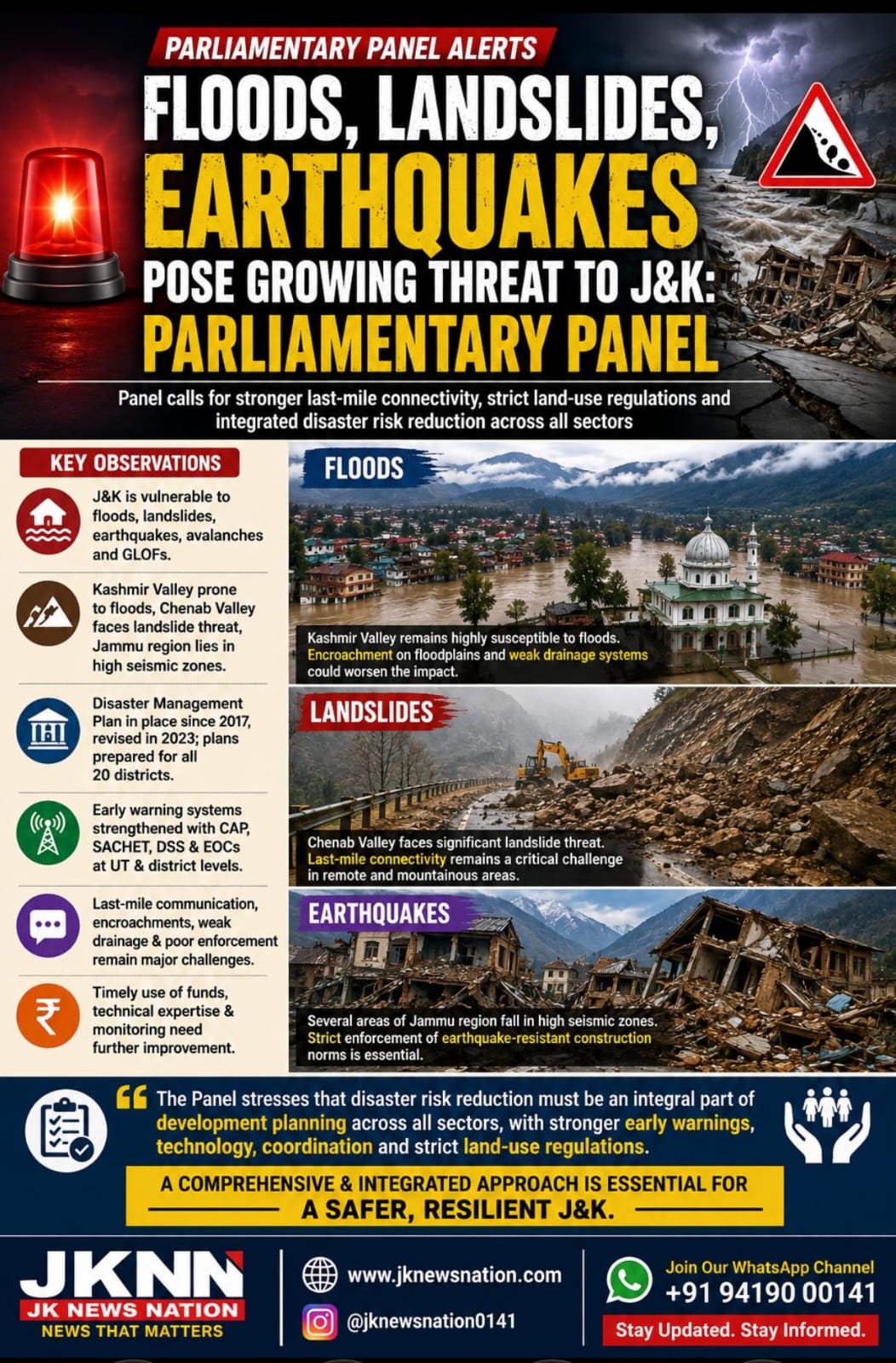
In its report submitted to both Houses of Parliament during the ongoing Monsoon Session, the Committee called for stronger last-mile connectivity, strict enforcement of land-use regulations, integration of disaster risk reduction into development planning, and enhancement of technological and institutional capabilities to ensure effective disaster response, relief and rehabilitation.
The Panel noted that Jammu and Kashmir’s fragile Himalayan ecology, challenging terrain and changing climatic conditions make the region vulnerable to multiple natural hazards, including floods, landslides, earthquakes, avalanches and Glacial Lake Outburst Floods (GLOFs).
The report highlighted distinct regional vulnerabilities, observing that the Kashmir Valley remains highly susceptible to floods, the Chenab Valley faces a significant threat from landslides, while several areas of the Jammu region fall within high seismic zones.
According to the Committee, Jammu and Kashmir has established a structured institutional mechanism for disaster management. The Disaster Management Plan was first notified in 2017 and revised in 2023 following the reorganisation of the erstwhile State and its alignment with the National Disaster Management Plan.
The Panel further noted that District Disaster Management Plans have been prepared for all 20 districts, providing institutional disaster-management coverage across the Union Territory.
The disaster management mechanism has also been strengthened through the reconstitution of the Disaster Management Authority and improved coordination among the UT, divisional and district administrations.
However, the Committee pointed out that challenges related to clarity of responsibilities, inter-departmental coordination and information sharing continue to persist, particularly in the period following administrative reorganisation.
The Panel stressed that disaster risk reduction should not be confined to individual infrastructure projects and must instead be made an integral part of development planning across all sectors.
The Committee appreciated measures taken to strengthen early-warning systems, including the adoption of the Common Alerting Protocol (CAP) and integration of alerts from agencies such as the India Meteorological Department (IMD) and the Central Water Commission (CWC).
It also noted that platforms including SACHET, Decision Support Systems and Emergency Operation Centres at the UT and district levels have helped improve real-time coordination and dissemination of emergency warnings.
Despite these initiatives, the Panel identified last-mile communication as a major challenge in remote and mountainous districts such as Kishtwar, Kupwara and Bandipora, where difficult terrain and communication limitations can delay the transmission of warnings and the mobilisation of emergency response teams.
On urban disaster preparedness, the Committee noted that measures such as de-silting of drains, strengthening of embankments and improvement of flood channels are being undertaken in cities including Srinagar and Jammu.
However, it flagged continuing concerns over encroachment on floodplains, inadequate drainage infrastructure and weak enforcement mechanisms, which could aggravate the impact of floods and other disasters.
The Parliamentary Committee further observed that regulatory provisions relating to earthquake-resistant construction and floodplain zoning are already in place, but their implementation remains inconsistent, particularly in peri-urban and rural areas.
The Panel also highlighted challenges related to the timely utilisation of disaster-management funds, availability of technical expertise and effective monitoring, despite the availability of funding mechanisms such as the State Disaster Response Fund (SDRF), Compensatory Afforestation Fund Management and Planning Authority (CAMPA) and various disaster-mitigation programmes.
Given Jammu and Kashmir’s mountainous geography and increasing climate-related risks, the Committee also took note of measures being undertaken for monitoring glacial lakes and developing mechanisms to mitigate the risks associated with Glacial Lake Outburst Floods (GLOFs).
The Panel described the constitution of dedicated committees and the undertaking of scientific studies and risk assessments as important steps towards building long-term disaster resilience in the Union Territory.
The Parliamentary Committee concluded that while Jammu and Kashmir has made considerable progress in disaster preparedness, greater attention is required to strengthen last-mile connectivity, enforce land-use regulations, mainstream disaster risk reduction across development sectors, improve early-warning dissemination and enhance technological and institutional capabilities.
The Panel stressed that a comprehensive and integrated approach would be essential to ensure more effective disaster preparedness, response, relief, rehabilitation and long-term resilience across Jammu and Kashmir. (KNC)
About The Author