
Power Tariff in J&K Likely to Rise From September 1 as JERC Approves 6.83% Average Hike
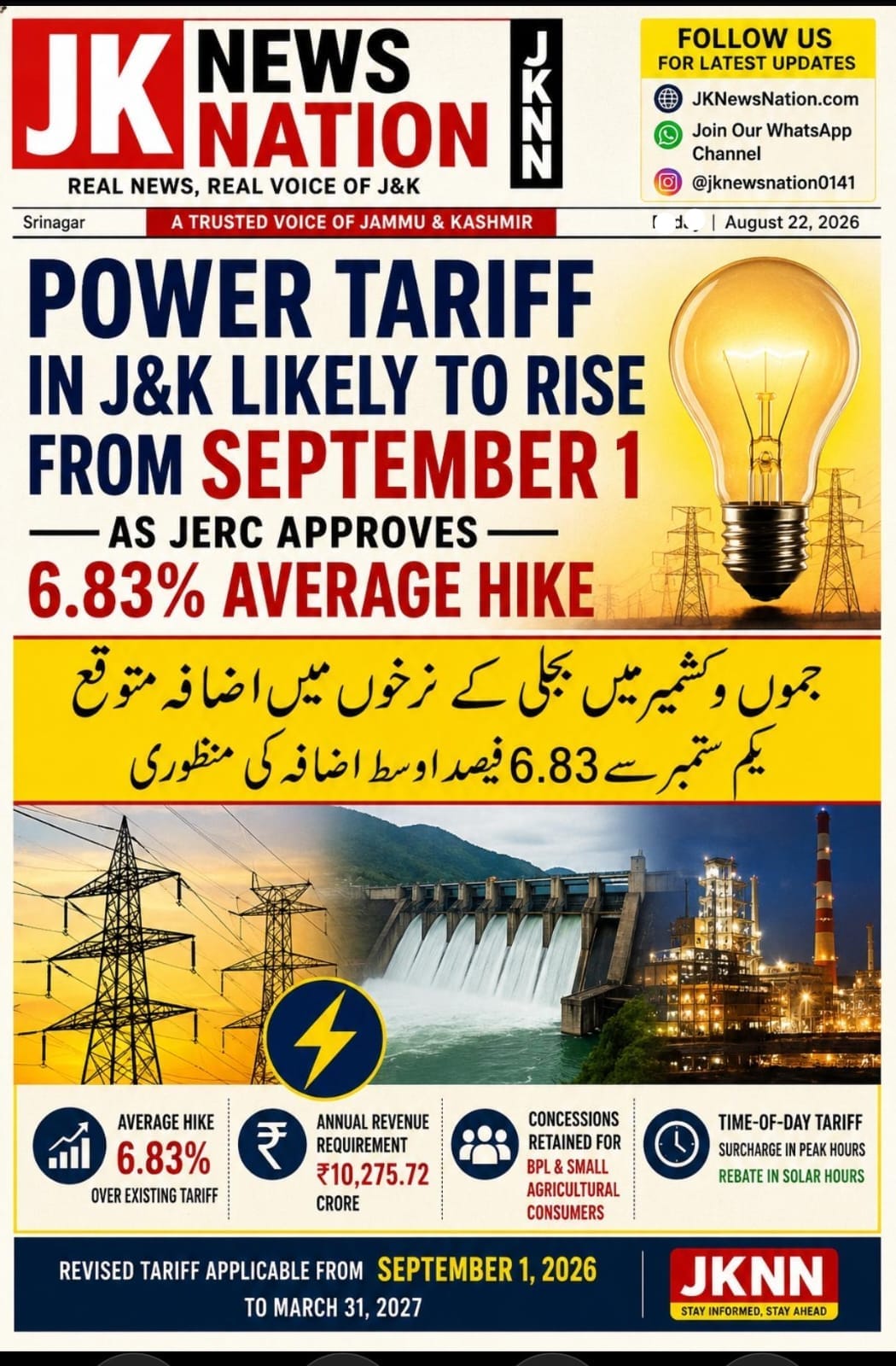
Srinagar, Aug 22, KNT: Electricity consumers across Jammu and Kashmir are likely to face higher power bills from September 1 after the Joint Electricity Regulatory Commission (JERC) approved a revised retail electricity tariff for the Jammu Power Distribution Corporation Limited (JPDCL) and Kashmir Power Distribution Corporation Limited (KPDCL) for 2026-27.
The revised tariff provides for an average increase of 6.83 per cent over the existing rates and will remain applicable from September 1, 2026, to March 31, 2027, unless modified or extended by the Commission.
While the increase is being projected as an average revision, the actual impact on individual consumers will depend on their category, monthly consumption, sanctioned load and, for certain consumers, the timing of electricity usage.
For metered domestic consumers, the energy charge has been fixed at ₹2.45 per unit for consumption up to 200 units, ₹4.20 per unit for 201 to 400 units and ₹4.60 per unit above 400 units. A fixed charge of ₹10 per kW per month will also apply.
The revised structure means households consuming more than 200 or 400 units could see their bills rise as additional consumption moves into the higher tariff slabs.
The Commission has retained concessional rates for BPL households and small agricultural consumers. Eligible BPL domestic consumers using up to 30 units a month will pay ₹1.40 per unit with a fixed charge of ₹5 per kW per month, subject to possession of a valid BPL certificate.
Small agricultural connections up to 20 HP will be charged ₹1.05 per unit, along with a fixed charge of ₹23 per HP per month.
Commercial consumers will also face revised charges, with single-phase non-domestic consumers paying ₹3.75 per unit up to 200 units and ₹5.70 per unit beyond that, along with a fixed charge of ₹75 per kW per month.
The revised tariff also changes rates for industrial consumers, including separate rates for LT and HT supply and additional benefits for eligible industries drawing electricity at higher voltages.
For eligible commercial and industrial consumers covered under the Time-of-Day tariff, peak-hour consumption will attract a surcharge, while a rebate will be available during solar hours. This means the timing of electricity consumption could also affect the final bill for such consumers.
JERC has approved a combined Annual Revenue Requirement of ₹10,275.72 crore for JPDCL and KPDCL for 2026-27. Against an estimated revenue of ₹7,352.87 crore under the existing tariff, the revised tariff is expected to raise revenue to ₹7,854.94 crore.
The remaining revenue gap of ₹2,420.78 crore is to be met through government subsidy and grant support.
The Commission has stated that recovering the entire revenue gap through tariff alone could have required an increase of around 40 per cent, indicating that government subsidy has helped contain the extent of the tariff revision.
Despite the subsidy component and concessions for certain categories, the revised tariff is likely to add to the electricity expenditure of a large section of consumers from September, particularly households crossing higher consumption slabs and commercial establishments.
The revised tariff order also covers EV charging stations, government departments, railway traction, bulk supply and temporary connections, while the Green Power Tariff has been retained at ₹0.50 per kWh over and above the applicable category tariff.
The Commission has also approved the Business Plan and Multi-Year Tariff framework for JPDCL and KPDCL for 2026-27 to 2028-29. [KNT]
About The Author