
NHAI Sets 10-Minute Response Time for Highway Ambulances; ₹10,000 Penalty for Delay
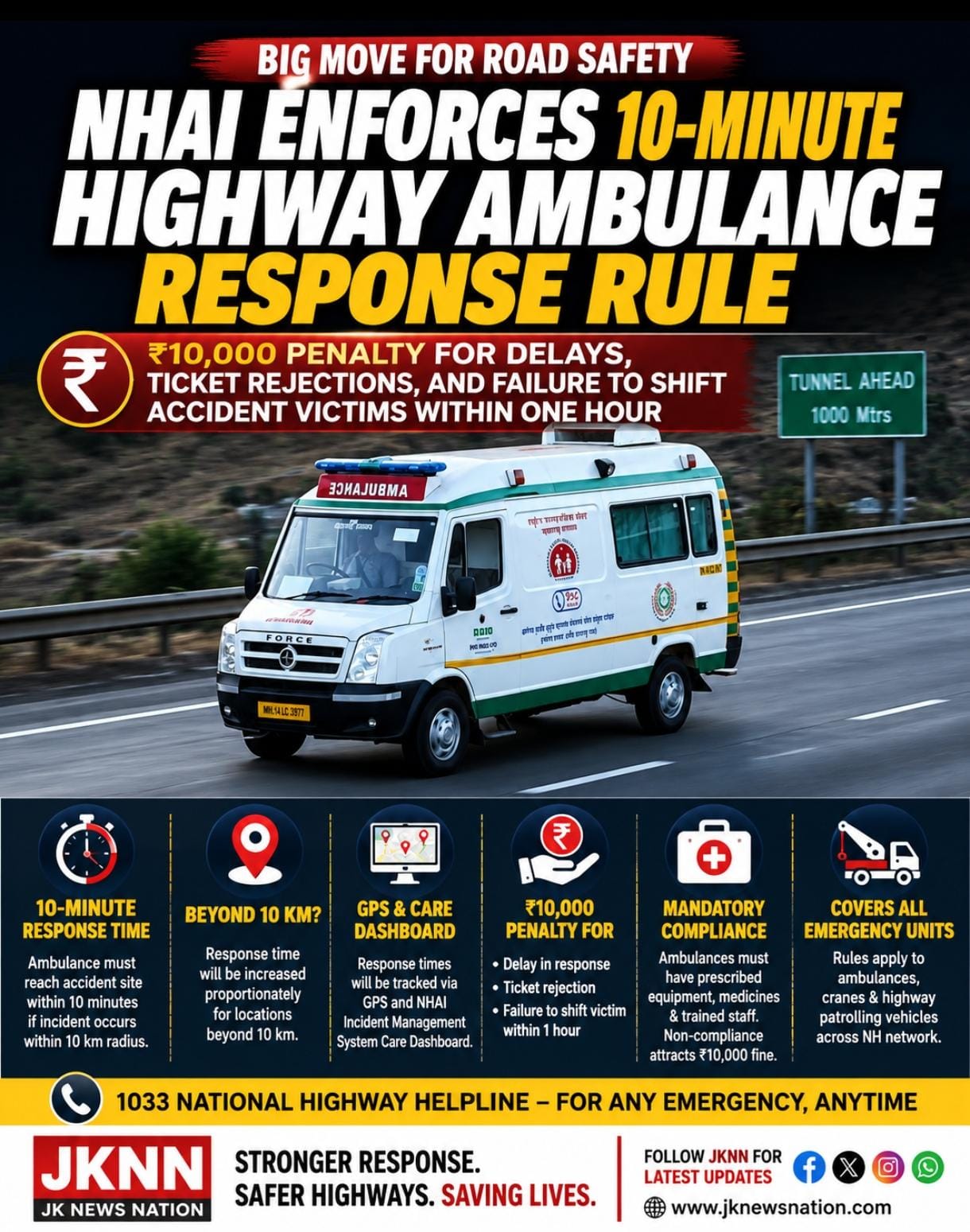
NEW DELHI, August 13 (KNC): The National Highways Authority of India (NHAI) has introduced stricter service-level standards for ambulances deployed on national highways, mandating that they reach accident sites within 10 minutes when the incident occurs within a 10-kilometre radius.
The new guidelines are aimed at reducing delays in emergency medical assistance, improving road safety and strengthening the Incident Management System on national highways.
Under the revised norms, an ambulance must reach the accident site within 10 minutes from the time an emergency ticket is accepted, provided the location falls within a 10-kilometre vicinity. For incidents located beyond 10 kilometres, the permissible response time will be increased proportionately.
NHAI said ambulance response times will be verified through Global Positioning System (GPS) data and the NHAI Incident Management System Care Dashboard.
The authority has prescribed a ₹10,000 penalty for every incident in which an ambulance fails to meet the stipulated response time. The same penalty may also be imposed if an ambulance rejects an emergency ticket.
The new guidelines further require ambulances to transport accident victims to the nearest hospital within one hour from the time of ticket acceptance. Failure to meet this requirement may also attract a ₹10,000 penalty.
NHAI has also made it mandatory for emergency-response vehicles to maintain the prescribed medical equipment, medicines and trained personnel in accordance with their contractual requirements. Any failure to comply with these provisions could result in another ₹10,000 penalty.
The revised standards cover not only ambulances but also cranes and highway patrolling vehicles, which constitute a critical part of the emergency-response network on national highways.
According to NHAI, around 3,000 ambulances and 1,000 patrolling vehicles and cranes are currently deployed across nearly 50,000 kilometres of national highways under its jurisdiction.
To strengthen real-time monitoring, AIS-140-compliant Global Positioning System devices have been installed on all on-road emergency-response units. Each vehicle has also been equipped with a dedicated Android-based Mobile Data Terminal with Internet of Things connectivity to facilitate communication, tracking and incident management.
NHAI has also highlighted the 1033 National Highway Helpline, which enables road users to report emergencies and seek immediate assistance on national highways.
The authority noted that delays in providing emergency assistance after road accidents have previously been highlighted by the Supreme Court Committee on Road Safety and the Comptroller and Auditor General of India.
NHAI has directed all Project Directors and Regional Officers to ensure strict implementation of the newly prescribed standards, stressing that timely emergency response is directly linked to public health, road safety and saving lives.
The highway authority has made it clear that any negligence or laxity in implementing the prescribed emergency-response standards will not be tolerated.(KNC)
About The Author